

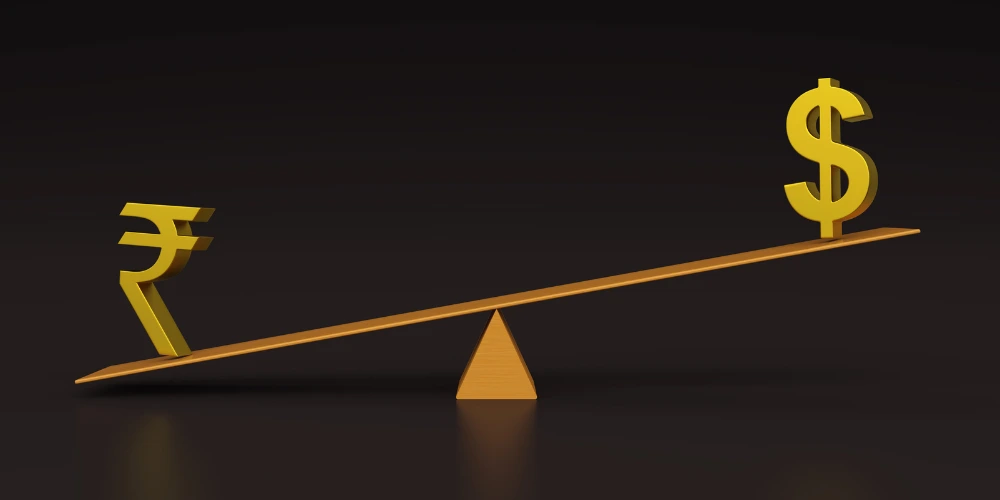
The Indian rupee has crossed a psychological threshold. For the first time in history, the rupee vs dollar rate has breached the 90 mark, touching 91.5 per dollar and hitting fresh all-time lows. This is not a temporary blip. It’s a structural shift that’s forcing high-net-worth individuals to fundamentally rethink how they construct and protect wealth.
The USD INR exchange rate started 2025 at 85.64 to a dollar. It took less than 15 trading sessions to cross the 91-rupee mark. Foreign investors have withdrawn $2.7 billion from Indian equities in January 2026 alone, adding to last year’s roughly $19 billion of net outflows. The message is clear. Indian rupee depreciation is no longer a gradual trend. It’s accelerating.
Table of Contents
- 1Understanding Indian Rupee Depreciation: The Long View
- 2What's Driving the Current Indian Rupee Fall?
- 3The 90+ Reality: What It Means for Wealth
- 4How HNIs Are Adapting: Portfolio Re-Engineering Strategies
- 5What to Expect: The Dollar to Rupee Rate Outlook
- 6The Role of Professional Portfolio Management
- 7Conclusion: Adapting to the New Normal
Understanding Indian Rupee Depreciation: The Long View
To understand where we are, we need to understand where we’ve been. Indian rupee depreciation has been a consistent feature since the 1991 liberalization. From ₹17 in 1991 to ₹90 in 2025, that’s 34 years of losing roughly 4.5% per year on average.
The rupee depreciation in the last 10 years tells a similar story. The Indian Rupee has weakened significantly, falling around 38% from 62.78 per dollar on March 6, 2015 to 87.12 per dollar on March 6, 2025. Research shows that in the last 5, 10, 15 and 20 years, the Indian rupee has depreciated by 3.9%, 3.4%, 4.3% and 3.5% respectively annually against the US dollar.
But 2025 was different. The rupee declined by around 5.5% in 2025, making it Asia’s worst-performing currency. The Indian rupee fall has been more pronounced this year than the historical average, and that acceleration is what’s catching HNI investors’ attention.
What’s Driving the Current Indian Rupee Fall?
The reason for rupee depreciation against dollar in 2026 is multifaceted, but three factors stand out above all others.
First is the trade imbalance and tariff uncertainty. India faces US tariffs of 50%, the highest globally, compared with an effective tariff of around 16% on ASEAN economies. The lack of progress on a US-India trade deal has weighed heavily on sentiment. After steep tariffs came into force in August 2025, India’s exports to the U.S. fell nearly 12% in September and 8.5% in October. While they rebounded sharply in November (rising 22.6%), the sustained uncertainty keeps pressure on the rupee vs dollar dynamics.
Second is foreign portfolio outflows. Foreign portfolio investors withdrew $18.5 billion in Indian equities on a year-to-date basis through 2025. Foreign investors have been bearish on India for most of the year, with net outflows of more than $10 billion across investment classes. When foreign capital exits, demand for dollars rises and the Indian rupee fall accelerates.
Third is the structural current account deficit. While India’s current account deficit is expected to be in the manageable level of 1%-1.5%, the country still runs a persistent deficit. This means higher demand for dollars for imports, with fewer offsetting inflows from exports or services. Gold imports have played a significant role, with rising imports widening the deficit and putting additional pressure on the rupee.
Grow your wealth with Bonanza
The 90+ Reality: What It Means for Wealth
The USD INR exchange rate at 90.19 on January 2, 2026 marked a psychological and practical turning point. For HNI investors, this Indian rupee depreciation creates both challenges and opportunities.
The immediate impact is on dollar-denominated liabilities and expenses. This depreciation inflated the expense of servicing India’s $682 billion in foreign debt and further strained the current account deficit. For individuals with children studying abroad, international healthcare needs, or global property investments, costs have jumped sharply. A $50,000 annual tuition fee that cost ₹42.8 lakh at ₹85.64 per dollar now costs ₹45.75 lakh at ₹91.5 per dollar.
The second impact is on investment returns. Domestic rupee-denominated portfolios have generated decent returns in rupee terms. But when measured in dollars, the Indian rupee fall erodes those gains for globally mobile HNIs. A portfolio that generated 12% rupee returns but faced 5.5% currency depreciation actually delivered only about 6% dollar-adjusted returns.
The third impact is on purchasing power and lifestyle. A weaker rupee raises import costs, contributing to higher domestic inflation. International travel, luxury goods, and imported products all become more expensive. The rupee vs dollar shift affects everyday purchasing decisions for affluent families.
How HNIs Are Adapting: Portfolio Re-Engineering Strategies
Smart HNI investors are not panicking. They’re adapting. Here’s how portfolios are being restructured to navigate the 90+ rupee era.
Strategy 1: Increasing Dollar-Denominated Asset Allocation
The most direct response to Indian rupee depreciation is increasing exposure to dollar-denominated assets. This includes US equities, global mutual funds, international ETFs, and offshore investment accounts. While traditionally HNI portfolios allocated 5-10% to international assets, many are now pushing that to 15-25%.
Investing in US stocks through global mutual funds and exchange-traded funds may help protect against rupee depreciation. The math is simple. If the dollar to rupee rate moves from 85 to 95, a portfolio with 20% dollar exposure automatically benefits from a 11.7% currency gain on that portion, partially offsetting the erosion elsewhere.
Strategy 2: Export-Oriented Equity Focus
Within domestic equity portfolios, HNIs are shifting toward export-oriented sectors. IT services, pharmaceuticals, chemicals, and textiles all benefit from a weaker rupee. These companies earn revenues in dollars but report costs largely in rupees. A weaker rupee can make exports more competitive, improving profitability for export-driven businesses.
Major IT companies have seen margin expansion during periods of rupee weakness. Every 1% depreciation in the rupee vs dollar typically translates to 30-40 basis points of operating margin improvement for large IT firms. Smart investors are overweighting these natural currency hedges within their equity allocations.
Strategy 3: Hedging Strategies and Structured Products
Sophisticated HNIs are exploring currency hedging strategies to protect existing rupee wealth. This includes currency-hedged funds, forex options, and structured products that provide downside protection against further Indian rupee fall while allowing participation in equity upside.
Market-linked debentures with built-in currency hedges are gaining popularity. These instruments allow investors to earn equity-linked returns while protecting against adverse movements in the USD INR exchange rate. While hedging comes with costs, many HNIs view it as insurance worth paying for during periods of structural depreciation.
Strategy 4: Real Assets and Gold
Gold has historically been a hedge against currency depreciation, and HNI investors are increasing gold allocations. Gold acts as a safe hedge during currency depreciation, particularly when priced in rupees. As the rupee weakens, gold prices in INR terms tend to rise, providing a natural offset.
Real estate in stable-currency jurisdictions is another strategy. Dubai, Singapore, London, and select US markets are seeing increased interest from Indian HNIs looking to diversify currency risk through tangible assets denominated in or linked to stronger currencies.
Strategy 5: Offshore Wealth Structuring
For ultra-HNIs, offshore wealth structuring has become a priority. This includes setting up international holding companies, trusts, and investment vehicles that hold assets in multiple currencies. The goal is not tax evasion but intelligent tax planning and currency diversification.
The rupee depreciation in the last 10 years has cost rupee-only portfolios roughly 32-40% in dollar terms. That’s a massive wealth erosion for globally mobile families. Offshore structures allow families to allocate wealth strategically across currencies based on where they expect to spend, live, or pass wealth to the next generation.
What to Expect: The Dollar to Rupee Rate Outlook
Forecasts for the dollar to rupee rate vary widely. Most analyst ranges place USD INR between 84 and 90 by year-end 2026 depending on scenario. Some major banks project mid-80s while others see the rupee vs dollar staying above 90 for an extended period.
MUFG expects the Indian rupee to appreciate modestly above the 90 level in 2026, targeting 90.80 by the September 2026 quarter. However, they note that risks tilt toward more rupee weakness if a trade deal between the US and India to lower tariffs is not reached.
The consensus view suggests continued Indian rupee depreciation with periodic reversals. The USD INR exchange rate forecast remains tilted toward controlled depreciation, with Fed policy and crude oil prices being the most influential drivers. While RBI intervention will prevent extreme deviations, it won’t offset long-term structural pressures.
The Role of Professional Portfolio Management
Navigating currency volatility while managing a diversified global portfolio requires expertise that goes beyond traditional wealth management. This is where professional Portfolio Management Services become invaluable.
Bonanza Wealth’s Portfolio Management Services help HNI investors construct currency-intelligent portfolios that balance domestic growth opportunities with international diversification. Through strategic asset allocation across geographies and currencies, active rebalancing during periods of volatility, and access to sophisticated hedging instruments, Bonanza PMS ensures that currency movements enhance rather than erode long-term wealth creation.
The firm’s approach combines quantitative analysis of currency trends with qualitative assessment of policy changes, trade dynamics, and capital flow patterns. For HNIs dealing with the complexities of the 90+ rupee era, having professional partners who understand both Indian markets and global currency dynamics is not optional. It’s essential.
Conclusion: Adapting to the New Normal
The Indian rupee falling to 90+ levels is not an aberration. It’s a structural shift driven by trade dynamics, capital flows, and long-term economic fundamentals. For HNI investors, this creates both urgent challenges and strategic opportunities.
The key is not to predict exactly where the rupee vs dollar will land. The key is to build portfolios resilient enough to preserve and grow wealth regardless of currency movements. That means diversifying across currencies, increasing exposure to natural hedges, exploring sophisticated protection strategies, and working with professional partners who understand the complexity of global wealth management.
The 90+ rupee era requires a new playbook. HNIs who adapt quickly, think globally, and manage currency risk proactively will not just survive this transition. They’ll thrive in it.
Ready to restructure your portfolio for the 90+ rupee reality? Connect with the Bonanza Wealth team today to discuss how we can help you build a currency-intelligent investment strategy that protects and grows your wealth across market cycles. Schedule your personalized portfolio review now.
For more information on rupee depreciation & its impact on the Indian Economy, read here.
Latest Posts
-
 14 Oct 2026
Nine Nights, Nine Checks: A Navratri Portfolio Review Checklist for 2026
-
 11 Oct 2026
Super El Niño and Warming Oceans: How 2027 Could Be Shaped, and What It Means for Indian Investors?
-
 09 Oct 2026
RBI Repo Rate Hike to 5.50%: What It Means for Your Loans, Savings and Investments?
-
 07 Oct 2026
World Bank Raises India Growth Forecast to 7.1%: What It Means for Your Investments?
Related Posts
-
 02 Apr 2026
₹95 and Beyond: Is the Rupee Signalling a Deeper Economic Shift?
-
 16 Jan 2026
Top 5 Alternative Investment Trends Reshaping HNI Portfolios in 2026
-
 26 Sep 2025
The Psychology of Wealth: A Dive Into the Mindset of Rich People
-
 26 Mar 2026
Silver: The Industrial Metal Powering the Next Decade of Growth





 Invest Now